How to Find the Right Customers: A Step-by-Step Process
Learn how to find the right customers by defining fit, researching needs, reaching them where they look, and tightening follow-up.

29% of U.S. consumers said they stopped using or buying from a brand because of poor customer experience online or in person, according to PwC's 2025 Customer Experience Survey of 5,511 consumers. Finding customers isn't just a visibility problem. You can reach someone who needs your offer and still lose them through a confusing buying process.
If you're working out how to find the right customers, start with commercial evidence, not a bigger audience. Identify who has a costly problem, understand everyone involved in approving the purchase, and reach them where they already seek reassurance. Then collect only the information you need to help them decide.
The Five Steps to Find the Right Customers
Most businesses choose a channel before they've identified what's holding sales back. Start with the constraint, because irrelevant attention, weak conversion and slow follow-up require different fixes.
Use this sequence to turn a broad market into a practical acquisition test.
Define the commercial outcome. Choose qualified enquiries, repeat purchases or a higher share of closed deals. Write down your current result and the target you want to reach, using a measure your team can update consistently. The output is a short outcome statement, not an ambition such as greater awareness.
Separate prospects into meaningful segments. Group them by observable need, industry, company size, location, buying trigger and decision-maker role. A local employer struggling with recurring payroll errors is a more useful segment than small businesses. The output is a shortlist of groups with distinct reasons to buy.
Validate the need. Compare customer conversations with your strongest accounts and channel-level conversion records. Look for recurring problems, triggers and buying conditions rather than enthusiastic reactions to your idea. The output is a problem statement supported by customer behaviour.
Score fit and intent separately. Decide what makes someone suitable for your offer and what indicates they're ready to act. Put those criteria in a shared sheet or CRM so the owner and sales team aren't qualifying enquiries differently. The output is a repeatable prioritisation rule.
Test a single combination. Choose a segment, a message and a channel, then set an end date before launching. Keep the offer and qualification process consistent enough to interpret the result. The output is a test you can expand, change or stop.
The workflow below connects those decisions to the buying process.
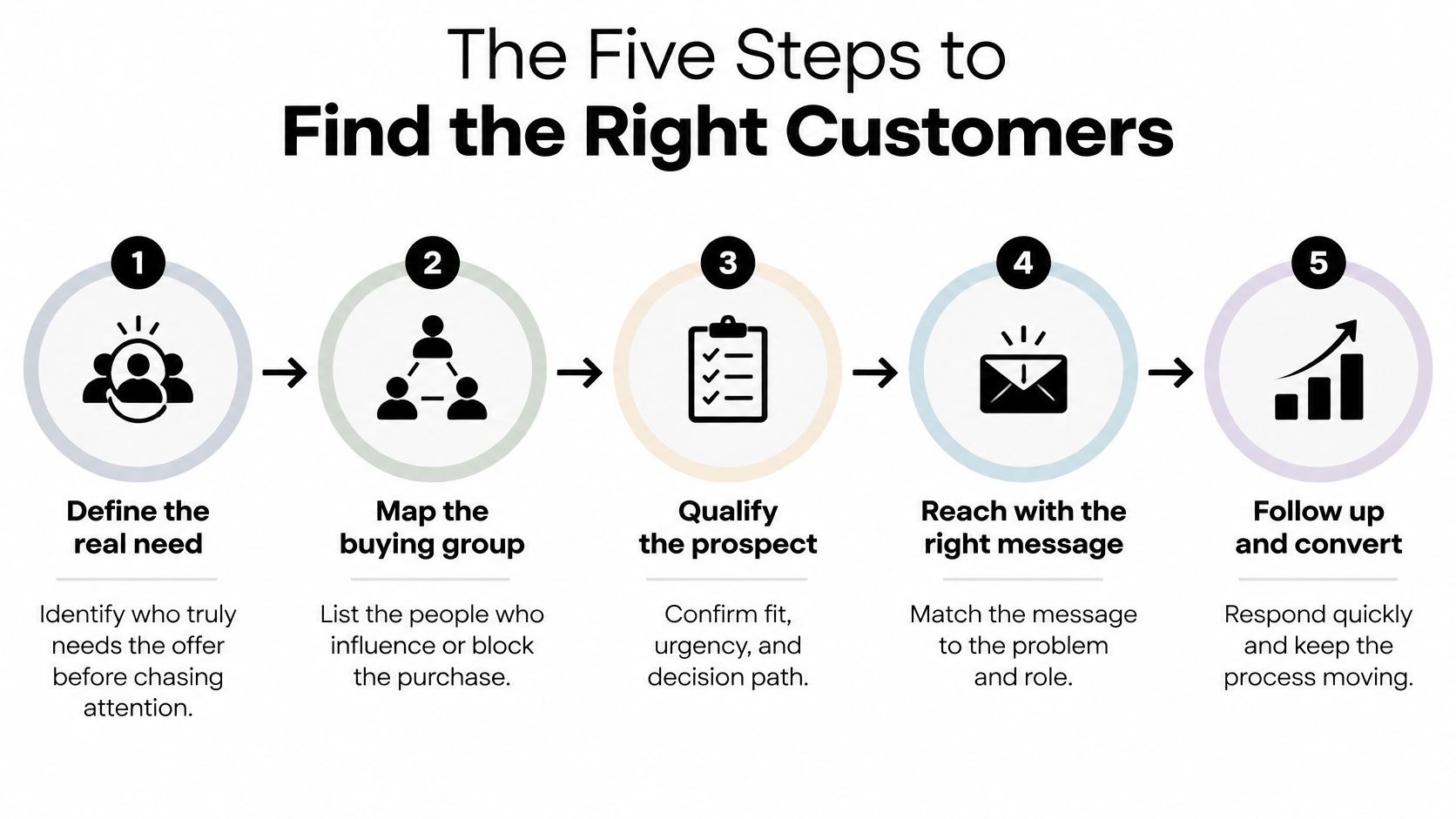
Keep the working documents small
Use a spreadsheet before buying another platform. Give each segment a row, record the evidence behind its ranking, and keep the scoring sheet beside the test plan.
You should finish with a ranked segment shortlist, a qualification sheet and a test with a fixed end date. If you can't explain why the leading segment deserves attention, you're not ready to spend more reaching it.
Practical rule: Diagnose the obstacle before increasing activity. More enquiries won't repair a buying process that loses suitable prospects.
Validate Needs With Five Customer Conversations
Start with a small, structured set of conversations, not a survey asking whether people like your offer. Include recent customers, lost deals and people who enquired but never bought. Their differences are often more useful than praise from satisfied customers.
Use the same core questions so you can compare answers:
- The original problem: What were you dealing with before you found us, and what did it cost you in time, money or lost customers?
- The buying trigger: What made you act then rather than put it off?
- The decision group: Who else was involved, and who could have stopped the purchase?
- The alternatives: What did you compare us against, and what made the difference?
- The expected outcome: What did you expect immediately after buying, and did it happen?
Look for agreement, not enthusiasm
Record answers against the customer's segment in Google Sheets or your CRM. Preserve the language people use to describe the problem. A phrase about invoices piling up is more useful for messaging than your internal description of administrative inefficiency.
Compare those accounts with your best existing customers. Check which industries, company sizes, locations and buying conditions recur, alongside sales-cycle length and profitability.
Treat a segment as credible when interviews, account records and channel outcomes point in the same direction. Where they disagree, investigate whether you've combined different needs into the same segment. Split it or drop it rather than forcing the evidence to fit.
Build a Customer Profile Scored on Fit and Intent
Fit means a prospect has a problem your offer can solve, the resources to buy and a workable decision path. Intent means they're showing signs of acting. Someone can be an excellent fit without being ready, or highly interested in something you shouldn't sell them.
Segmentation is useful, but a label isn't proof of commercial value. A review published in the Journal of Marketing Analytics notes that relatively few studies provide strong empirical evidence for segmentation's commercial benefits. Build your profile around observable problems and buying behaviour, then check whether it predicts profitable customers.
Use a starting model, not a scientific-looking guess
The following is an illustrative scoring model, not a validated benchmark. It deliberately gives fit more influence than activity, so an unsuitable prospect doesn't become a priority by clicking repeatedly.
Fit and intent criteria with starting weights
| Criterion | Type | What to check | Starting weight |
|---|---|---|---|
| Problem severity | Fit | Does the problem cost them time, money or customers every month? | 25% |
| Budget range | Fit | Can they pay your typical price without a special arrangement? | 15% |
| Decision authority | Fit | Is the contact the decision-maker, or can they reach one quickly? | 15% |
| Use-case match | Fit | Does your core offer solve the problem they described? | 15% |
| Recent enquiry | Intent | Have they recently asked about price, availability or timing? | 10% |
| Referral | Intent | Did they arrive through an existing customer or trusted partner? | 10% |
| Repeat visits | Intent | Have they returned to service or pricing pages, where this is transparently observed? | 10% |
Award the available points when you have supporting evidence. Mark unknowns separately rather than treating missing information as proof of poor fit. Ask about anything that could change the next action.
Don't let a total score override a fundamental mismatch. If you can't deliver the required service, an enthusiastic enquiry still shouldn't enter the sales pipeline.
Revise the profile around completed deals
Say a bookkeeping practice compares employers with recurring invoice backlogs against sole traders seeking occasional advice. If the employer segment consistently buys the recurring service and stays profitable to serve, the practice should narrow its profile around that need. That's a hypothetical decision pattern, not a claim about bookkeeping conversion rates.
Review the weights against closed-won and closed-lost records. Check whether referrals predict purchases and whether apparent page activity adds anything beyond a direct enquiry.
Lead volume is the wrong success measure when a broader audience leaves your team handling more unsuitable conversations. Review win rate, sales-cycle length, gross margin, retention and acquisition cost by segment each quarter. Keep the profile only while the results justify it.
Map the Whole Buying Group Before You Pitch
A single customer persona is often too simple for a business purchase. Your enthusiastic contact may experience the problem without controlling the budget, approving the contract or doing the implementation work.
Edelman's analysis of hidden B2B buyers reports that more than 40% of B2B deals stall because of internal misalignment, while 71% of hidden buyers have little or no interaction with sales teams. Finance, legal, procurement, compliance and operations can delay or block a purchase without appearing in your usual sales conversations.
These stakeholders need reasons to support the change, not another version of your product pitch.
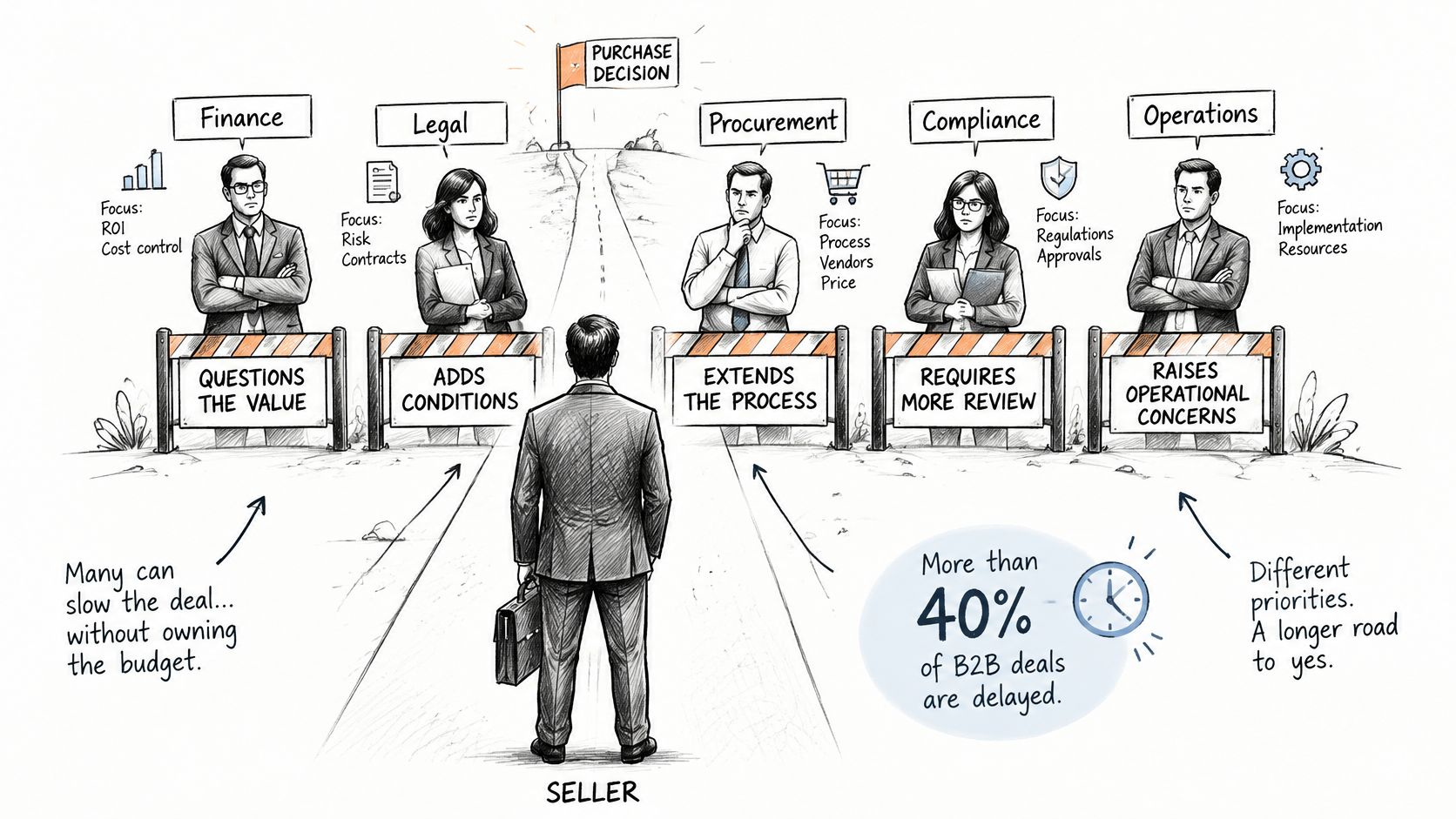
Give each role its own case
Map the following roles for each segment. In an owner-managed business, someone may occupy several roles, but the approval questions still need answers.
Buying group roles for each segment
| Role | Who it is | What value means | Evidence it needs |
|---|---|---|---|
| Problem owner | Person who experiences the problem daily | Operational relief in daily work | Workflow example or demo |
| Budget owner | Person accountable for spend | Financial case with a clear payback period | Cost comparison and forecast |
| Risk and implementation | Finance, legal, compliance or operations | Safety, compliance and reliability | Policy documents, references and rollout plan |
Ask these questions during the first substantive conversation:
- Approval: Who else must approve this change?
- Adoption: What could stop people using it after it's bought?
- Evidence: What does each person need to see before saying yes?
Don't ask your contact to guess everyone's objections. Offer a short joint conversation or prepare material they can share internally.
Make the map specific to the purchase
Consider a service business evaluating an enquiry-management system. The office manager wants fewer missed messages and a clear work queue. Show a sample enquiry moving from arrival to assignment and follow-up.
The owner needs to understand the cost and the assumptions behind the financial case. Provide a comparison of the current process with the proposed one, clearly separating measured costs from estimates.
The operations lead wants to know who maintains the system and what happens when someone is absent. Give them a rollout plan, ownership checklist and fallback procedure.
The right customer is often a buying group that can agree on the change, not merely a person who likes the offer.
Find Where Your Best Customers Already Look
Choose channels by where suitable customers seek reassurance, not where you can reach the largest audience. An introduction from a relevant partner and a broad advertising impression don't start the same conversation.
In Nielsen's 2013 survey of more than 29,000 consumers in 58 countries, 84% trusted recommendations from family and friends, while online consumer opinions prompted action among 70% of respondents. That's historical consumer evidence, not a forecast of your channel performance. Use it as a reason to investigate trusted discovery routes, not to assume referrals will always win.
Channels where ideal customers can be reached
| Channel | Best for | Signal to track | Common mistake |
|---|---|---|---|
| Existing customers and referrals | Trusted introductions | Referral source recorded on each enquiry | Asking for introductions without a clear reason |
| Review platforms and directory listings | Buyers comparing options | Review count and enquiries that mention a listing | Leaving reviews unanswered for weeks |
| Industry associations and local groups | Niche or local services | Event or group sign-ups that lead to conversations | Pitching in the group instead of helping |
| Partners serving the same clients | Complementary services | Introductions received per partner each quarter | Vague referral terms that nobody follows up |
| Search and paid advertising | Buyers already looking for a solution | Cost per qualified enquiry | Paying for clicks from the wrong segment |
| Niche social communities | Visible, recurring problems | Conversations started that match the profile | Chasing volume over fit |
Follow evidence from existing customers
Begin with the places where customers already discuss your business and the channel behind your strongest accounts. If those are the same place, concentrate there before adding another channel.
Ask new customers where they first heard about you and what helped them decide. Those may be different answers. Someone might discover you through search but only enquire after reading reviews or speaking to a colleague.
Make referrals easier by describing the problem you solve and the people you can help. A partner needs a recognisable situation to act on, not a vague request to send business your way.
- After a successful outcome: Ask for an honest review while the experience is fresh, without prescribing what the customer should say.
- For complementary partners: Agree who makes the introduction, what permission is needed and who follows up.
- For search campaigns: Check actual search terms and qualified enquiries, not just clicks.
- For communities: Answer specific questions and demonstrate useful judgement before inviting a sales conversation.
A channel producing fewer enquiries can deserve more effort if those enquiries become profitable customers. Compare wins and revenue alongside the time your team spends handling each source. Cheap attention isn't cheap when the owner has to qualify every unsuitable lead personally.
Qualify Prospects Without Overreaching on Data
A prospect worth winning does not need a dossier. They need a clear reason to trust the next step, and you need enough to judge whether the work fits.
People want offers that match the problem they described. They also resist handing over personal details to get that match. Ask for less, and say why you are asking. Limited questions, explained in plain terms, filter suitable buyers better than watching every click.
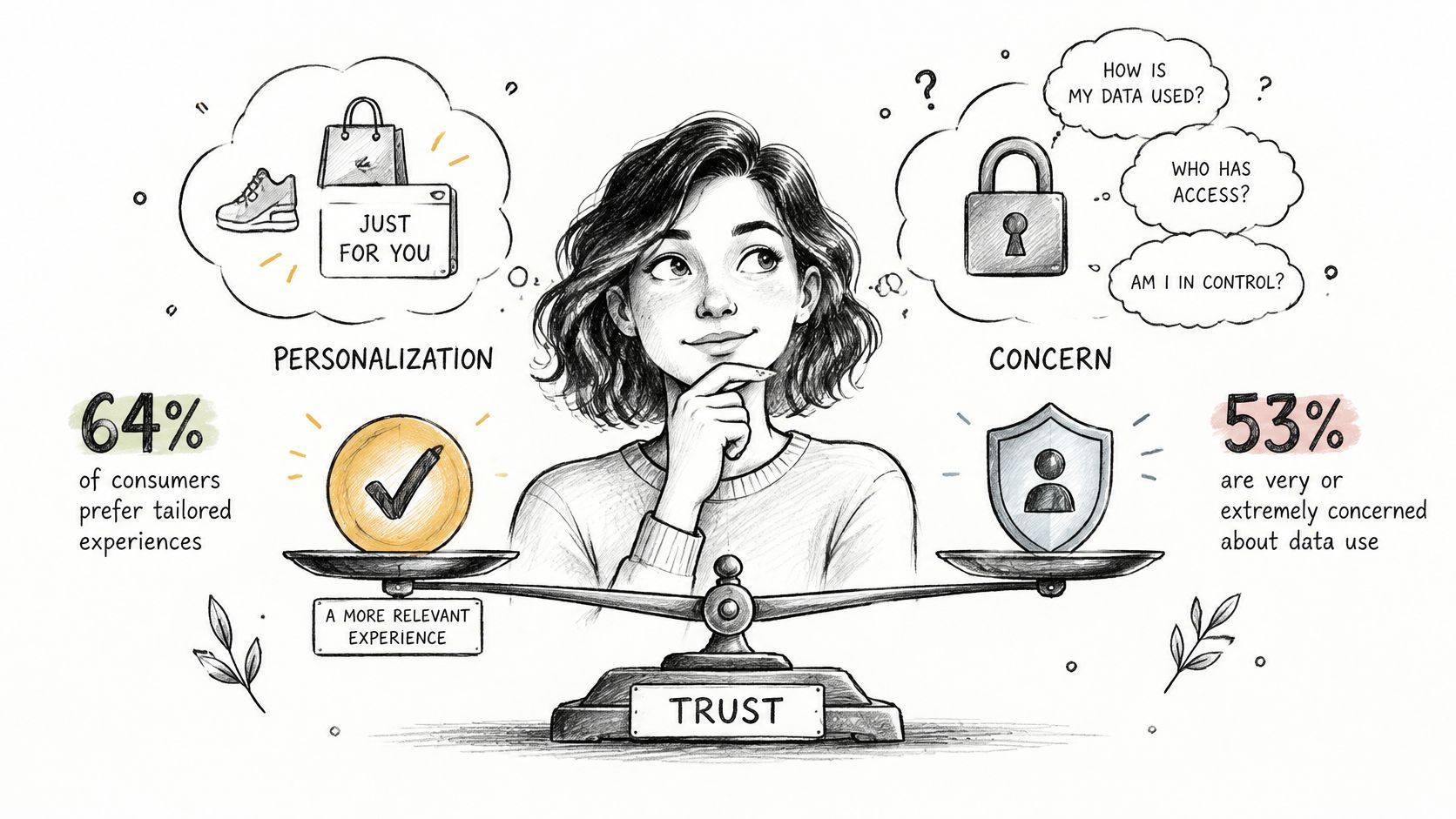
Apply minimum necessary relevance
Minimum necessary relevance means you request a fact only when it changes qualification, routing, or the recommendation. Start with what the prospect already volunteers: the problem, the timing, the service location, and the requirements. If a budget range would stop an unsuitable recommendation, ask for a range and state that purpose.
Treat the enquiry as a buying group, not a browser profile. You need the writer's role, who else must agree, and whether they reached you through a channel they already trust. That is enough to decide the next conversation. It is not a reconstruction of someone's life.
Review every form field with one test: what does the team do differently because of this answer? If nobody can name an action, remove the field or defer it until a conversation.
- Explain each field: A service postcode can confirm coverage. It does not justify a full address on the first form.
- Prefer direct evidence: Use enquiry and purchase history before financial or social-media signals. Publicly visible information is not a reason to build an intrusive profile.
- Offer control: Give a clear way to correct or request deletion of stored details, and assign someone to handle those requests.
- Avoid sensitive inference: Do not infer health, religion, or financial circumstances from browsing behaviour.
- Decline poor-fit demand respectfully: State the mismatch, and point to a useful resource or another service category when you can.
Do not add mandatory fields just to fill a scoring sheet. Suitable prospects leave. Your team stores answers it will never use.
Qualification principle: Ask enough to recommend the next step, not enough to reconstruct someone's life.
Judge the system by two results. Your team can identify suitable work, and the prospect gets a useful answer. Transparent, limited data does that job. Extensive tracking usually does not.
Respond Fast and Follow Up on a Schedule
Once a suitable prospect enquires, someone needs to take responsibility. Finding the customer and handling the enquiry are parts of the same commercial process.
A study of approximately 1.25 million leads, described in Vida's speed-to-lead analysis, found that organisations attempting contact within an hour were nearly seven times more likely to qualify a lead than those waiting an additional hour. That finding concerns qualification, not guaranteed sales, but it gives owners a clear reason to inspect response delays.
Give every enquiry an owner and a next action
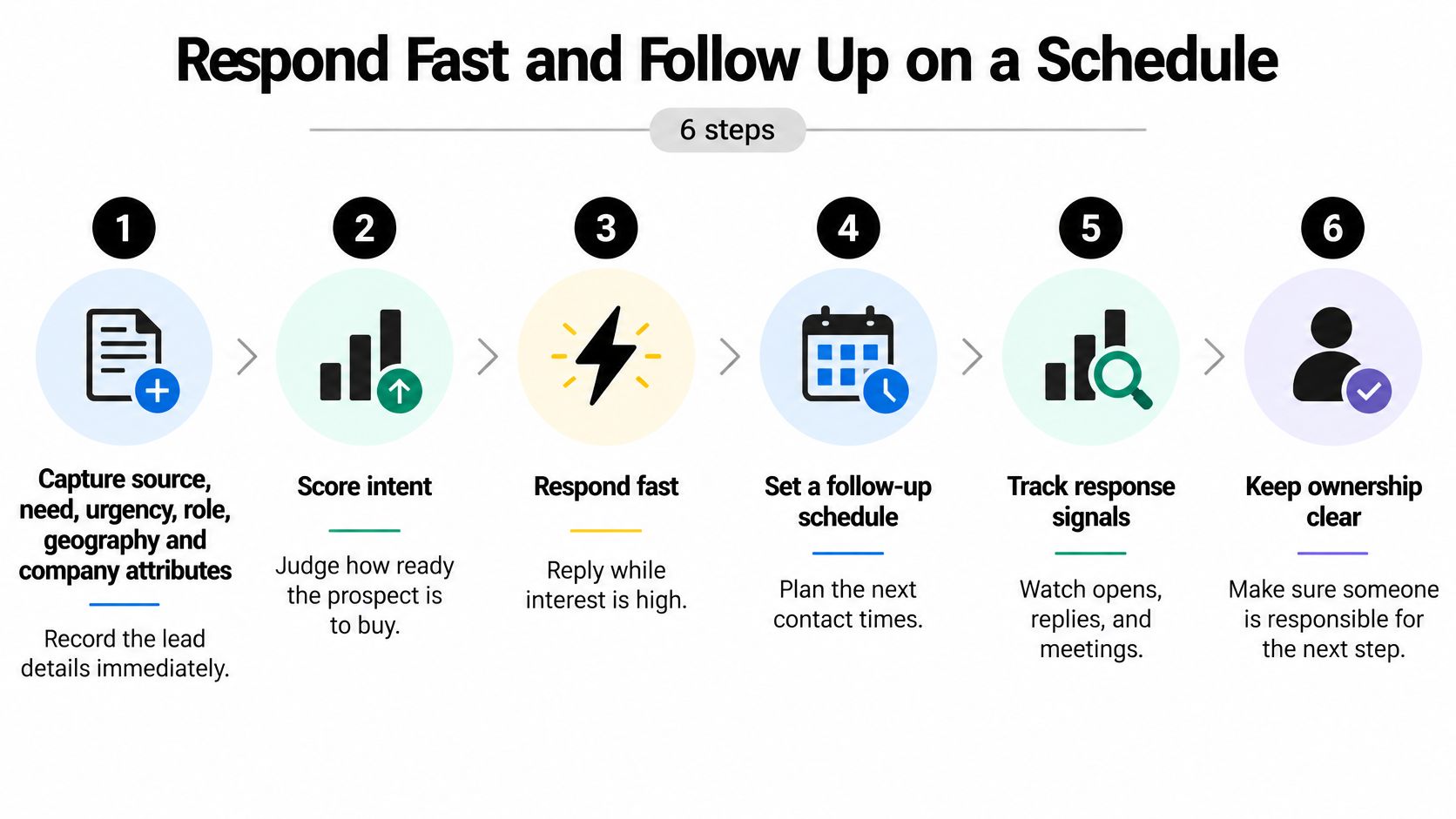
Capture the essentials. Use a standard form or CRM record for source, need, urgency, role, geography and relevant company attributes. Let staff add information learned during the conversation rather than forcing everything into the initial form.
Route by fit and intent. Assign a named owner according to service needs and priority. A shared inbox can be the entry point, but it shouldn't be the final destination.
Acknowledge the actual request. Confirm what the prospect asked about, explain what happens next and give a realistic response commitment. A generic receipt notification doesn't resolve uncertainty.
Attempt a human conversation promptly. For urgent, high-fit enquiries, make immediate contact where staffing allows. If the business is closed, state when someone will respond rather than implying continuous availability.
Set channel-appropriate follow-up. Return a phone enquiry by phone where appropriate. Use email for documents and detailed comparisons, and respect the expectations and permissions associated with messaging channels.
Measure progress through the pipeline. Track contact rate, qualified-conversation rate, opportunity rate, win rate, response-time distribution and revenue by source. Agree what each stage means before staff start reporting it.
Use the workflow as an operating checklist, not just a sales-team reminder.
Correct the failures that hide in ordinary routines
- Unmonitored inbox: Assign coverage and a backup owner for absences.
- Misleading average: Inspect overdue enquiries and the slowest responses, not just the overall average.
- Identical follow-ups: Adapt the next contact to the prospect's problem and unresolved decision.
- Automation mistaken for service: Record the first meaningful human response separately from the acknowledgement.
A useful follow-up answers a question, provides missing evidence or proposes a clear next step. Repeatedly asking whether someone has seen your email adds work without helping them decide.
Test One Segment Before You Expand
Run a bounded test with a defined segment, message and channel. Set the success threshold before launch using your current qualified-conversation rate, response time, win rate and acquisition cost.
Keep a short test record in Google Sheets or your CRM. Include the audience definition, message, channel, budget limit, end date and reviewer. Don't change several variables midway unless you're stopping the test and recording why.
Set the decision rule in advance
Expand only when the segment improves win rate without an acquisition cost your gross margin can't support. If the buying cycle hasn't finished, keep the result open rather than counting promising conversations as wins.
When results disappoint, inspect the stage where prospects stopped progressing. Poor qualification suggests a relevance problem; response delays suggest an operational failure; suitable conversations without purchases call for closer examination of the offer, evidence and approval process.
Before launching, confirm:
- Buying group: You know who experiences the problem, approves spending and carries implementation risk.
- Enquiry capture: Source and urgency are recorded.
- Ownership: Every enquiry has someone responsible for the next action.
- Scoring: Criteria reflect completed deals where evidence exists, and assumptions are clearly marked.
This week, write the success threshold, end date and reviewer's name beside your scoring sheet. Make that decision before spending more on customer acquisition.
Producant helps businesses find relevant customers, improve the experience that turns interest into sales, and establish clearer enquiry handling and follow-up processes. Visit Producant to discuss where your business is losing suitable opportunities and identify a practical, measurable place to start.