How to Retain Existing Customers and Build Trust in 2026
Learn how to retain existing customers and build trust with practical steps for measurement, follow-ups, service recovery and feedback that works.

How to retain existing customers and build trust starts with ordinary handling, not a bigger offer. Mishandled customer data drives that trust away. A surprise invoice, or personal details used without a clear reason, can undo years of good work. I treat that trail of contacts as the retention record. A fair explanation beats a fast apology. Personalisation that overreaches can erode the trust it was meant to build.
Trust Is the Operating Habit Behind Retention
Trust is an operating habit, not a slogan. Customers stay when your business repeatedly shows competence, fairness, and relevance in small interactions. They leave when each contact asks them to chase, repeat themselves, or guess what happens next.
The 2025 Edelman Trust Barometer, based on more than 33,000 people across 28 countries interviewed from October 25 to November 16, 2024, found that 80% of people trust the brands they use. Yet 61% of respondents globally reported a moderate or high sense of grievance, and among people with high grievance, business was rated 81 points lower on ethics and 37 points lower on competence than among people with low grievance. Your existing customers start from a position of trust, but many are primed to withdraw it.
What This Looks Like Day to Day
Say a two-person bathroom refitter finishes a solid first job. The customer asks about a second bathroom and is promised a callback "this week." Nobody calls. The customer phones twice, gets vague reassurance, and books a competitor who names a date. The workmanship didn't lose that job. The missed promise did.
Retention turns on whether customers believe the next interaction will be as reliable as the last one.
That's why the practical sequence is simple: measure retention first, segment and time follow-ups, set communication standards, recover fairly, use feedback carefully, then pick one move for 90 days.
Don't start with a loyalty scheme. Start with your record. List the last ten times a customer had to chase you for a reply, a date, a price, or an update. Note what each delay cost in goodwill, extra staff time, discounts, or lost repeat work. You'll usually find the retention problem in that list.
Measure Retention Before You Change Anything
Start with the common error. You begin a quarter with 100 customers, end with 85 customers, and acquire 10 new customers during the period. Your customer retention rate is 75%, not 85%, because you subtract new customers from the ending total before dividing by the starting total.
The formula is (customers at period end minus new customers acquired) divided by customers at period start. Use a fixed measurement window every time. I would use quarterly measurement for most owner-managed businesses and monthly measurement where customers buy frequently. Changing the window when results look weak only hides the problem.
Metrics Worth Tracking
| Metric | How to calculate | What it reveals |
|---|---|---|
| Customer retention rate | (customers at period end minus new customers acquired) divided by customers at period start | Whether existing customers stay |
| Repeat purchase rate | Customers with two or more orders divided by all customers in the window | Whether a first sale turns into a habit |
| Time to next purchase | Median days between orders for each customer | Your expected repurchase interval for timing follow-ups |
| Reactivation rate | Lapsed customers who buy again divided by all lapsed customers | Whether win-back contact works |
| Complaint recurrence | Customers with a repeated issue divided by all customers who complained | Whether fixes actually hold |
| Revenue retention | Revenue from existing customers this period divided by their revenue last period | Whether retained customers spend more or less |
You can build all six from a simple order export with customer name, order date, order value, and complaint record. Repeat purchase rate tells you whether customers come back once. Time to next purchase tells you when silence becomes abnormal. Revenue retention catches a quieter problem, customers who stay on your list but spend less each period.
Separate customers by first-purchase month so new-customer growth doesn't hide churn among older accounts. A business can grow total customer numbers while losing its oldest, most profitable buyers. Cohort tracking shows which month's customers drift and when the drift starts.
Why Averages Mislead You
Use the median time to next purchase, not just the mean. A handful of customers who return after a very long gap can stretch the average and make your normal interval look longer than it is. Check the spread as well. If most customers reorder within a tight band, timing follow-ups is easy. If intervals vary wildly, you need customer-level timing instead of one company rule.
Pay special attention to complaint recurrence. One complaint may reflect bad luck or a one-off mistake. A repeated complaint from the same customer, or the same issue across several customers, shows that your fix didn't hold and your process still produces the failure.
Spend one week on the baseline. Pull two years of order data, calculate retention for each quarter, and mark every customer's last purchase date. Don't change scripts, offers, or follow-up timing until you know where customers are leaving.
How to Segment Customers and Time Your Follow-Ups
Timing matters more than volume. A message sent when a customer usually reorders feels helpful. The same message sent to everyone on the first Monday of the month feels like noise, and customers learn to ignore it.
- Export the basics. Pull last purchase date, order count, and order value for every customer from your invoicing system, shop platform, or a spreadsheet. Clean duplicates first, because one person under two records will look like two lapsed customers.
- Calculate each customer's own interval. Work out the typical gap between that customer's orders. A customer who buys every three weeks shouldn't be judged against a customer who buys twice a year.
- Sort customers into four groups. Place them in active, due, lapsed, and high-value at risk using the rules in the table below. This turns a long customer list into a short list of decisions.
The sequence below shows the working flow from export to timed contact.
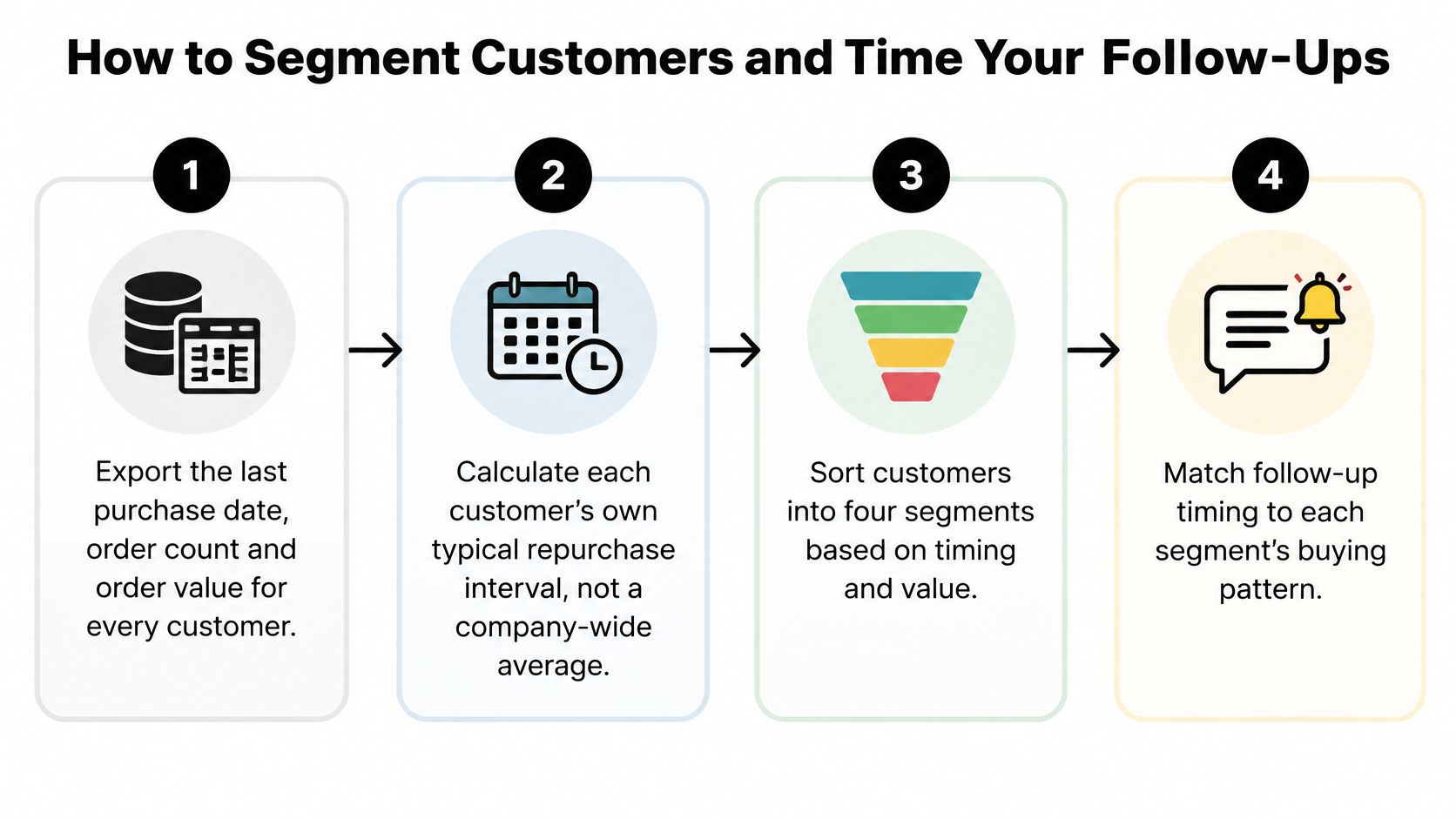
- Trigger contact on changed behaviour. Send one proactive message when a customer passes about 1.2 times their usual interval. You're responding to a delay in their pattern, not filling a marketing calendar.
- Make the message specific. Name the product or service they last bought and note when they'd normally reorder. "You usually reorder the 5-litre container around now, do you want the same again?" works because it's recognisable and easy to answer.
- Stop when they respond. End the sequence the moment the customer replies or buys, and log the outcome against the customer record. Continuing reminders after a purchase tells the customer your records aren't reliable.
| Segment | Rule | Action |
|---|---|---|
| Active | Last order within own usual interval | Normal service, no extra contact |
| Due | Past about 1.2 times own usual interval | One specific proactive contact naming last product |
| Lapsed | Past twice own interval | Win-back message without a discount in the first contact |
| High-value at risk | High past value and now overdue | Named owner contacts the customer personally |
What Not to Do
Avoid fixed-calendar blasts to your whole list. They create fatigue because most recipients aren't due, don't need anything, and get no useful signal from the message. Avoid leading with discounts too. A discount may restart an order, but it also cuts margin and can train customers to wait for the next promotion instead of buying at their natural interval.
Test before you scale. Leave about 10% of due customers untouched for one month as a holdout group, then compare purchases between contacted customers and that control group. Some "due" customers would have bought anyway. The holdout tells you how many extra orders your contact created, which is the only number that justifies the work.
For project businesses with no stable buying cadence, replace the repurchase interval with a service-date trigger. Contact each customer a set number of months after the last job to check performance, servicing, or known wear points. Track the same retention and reactivation measures so the method stays accountable.
Communicating Consistently Without Sounding Scripted
Say the same two-person bathroom refitter promises a callback "this week" and misses it twice. The customer doesn't conclude that the team is busy. She concludes that she'll have to manage them through the next job too, and that effort makes a competitor look safer. The fix isn't charm. It's a dated callback in the diary and a short text whenever that date slips.
Consistency comes from standards, not scripts. A script forces everyone to say the same words. A standard forces everyone to meet the same commitments while still sounding like a person who knows the customer.
Set the core standards in writing:
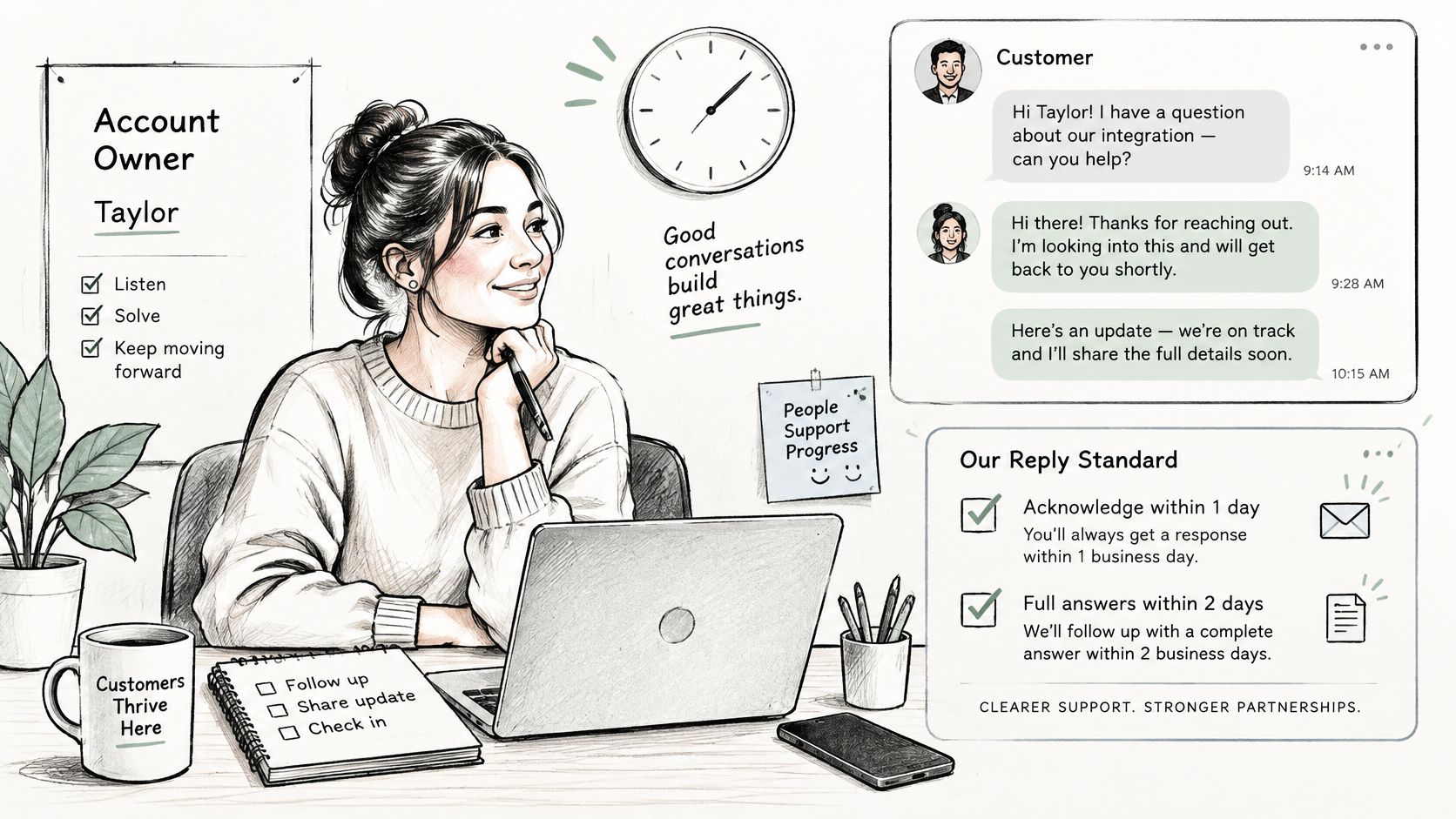
- One named owner. Give every account a person responsible for replies and follow-up, so the customer knows who'll answer and nothing sits in a shared inbox unowned.
- A reply standard. Acknowledge within one business day and answer fully within two business days unless you've named a later date and explained why.
- A shared enquiry history. Log quotes, promises, dates, and complaints where any colleague can see them, so the customer never has to repeat the story.
The owner below is doing the unglamorous part of retention, keeping the record straight so the customer doesn't carry it.
Setting Expectations Early
State the essentials at first contact: the delivery window, the price, and what happens if something is delayed. Customers tolerate delay far better when you tell them before they discover it. Don't promise a date to end an awkward conversation. A realistic date you meet builds more confidence than an optimistic one you miss.
Announce changes before they happen. A price rise explained 30 days in advance, with the reason and the date it applies, is rarely a reason to leave. The same rise discovered on an invoice feels like concealment, and customers start checking alternatives even if the new price is fair.
Use the customer's own words when you reply. If she says the shower "runs cold after five minutes," use that phrase rather than translating it into internal jargon. It shows you listened and reduces the risk that you solve a slightly different problem.
Before you send: Is it accurate, does it promise only what you can keep, and does it name the next step with a date?
Run every substantive message through those three questions. If the next step depends on a supplier or a colleague, say when you'll have the answer and contact the customer on that date even if the answer is still pending. Silence is what customers remember.
Resolving Friction and Recovering From Service Failures
A service failure is a fairness problem, not just a speed problem. Customers judge whether the outcome was proportionate, whether the process was understandable, and whether they were treated with respect. A fast refund with a dismissive explanation can still lose the customer.
Complaint-handling findings summarised in MIT Sloan Management Review on recovering from service failure show that distributive, procedural, and interactional fairness together explained 85% of the variation in satisfaction with complaint handling. In the same body of work, favourable employee behaviour had the strongest effect on post-complaint experience, followed by organisational procedures and then compensation. Your staff conduct matters more than the size of the remedy.
Seven Steps That Make Recovery Fair
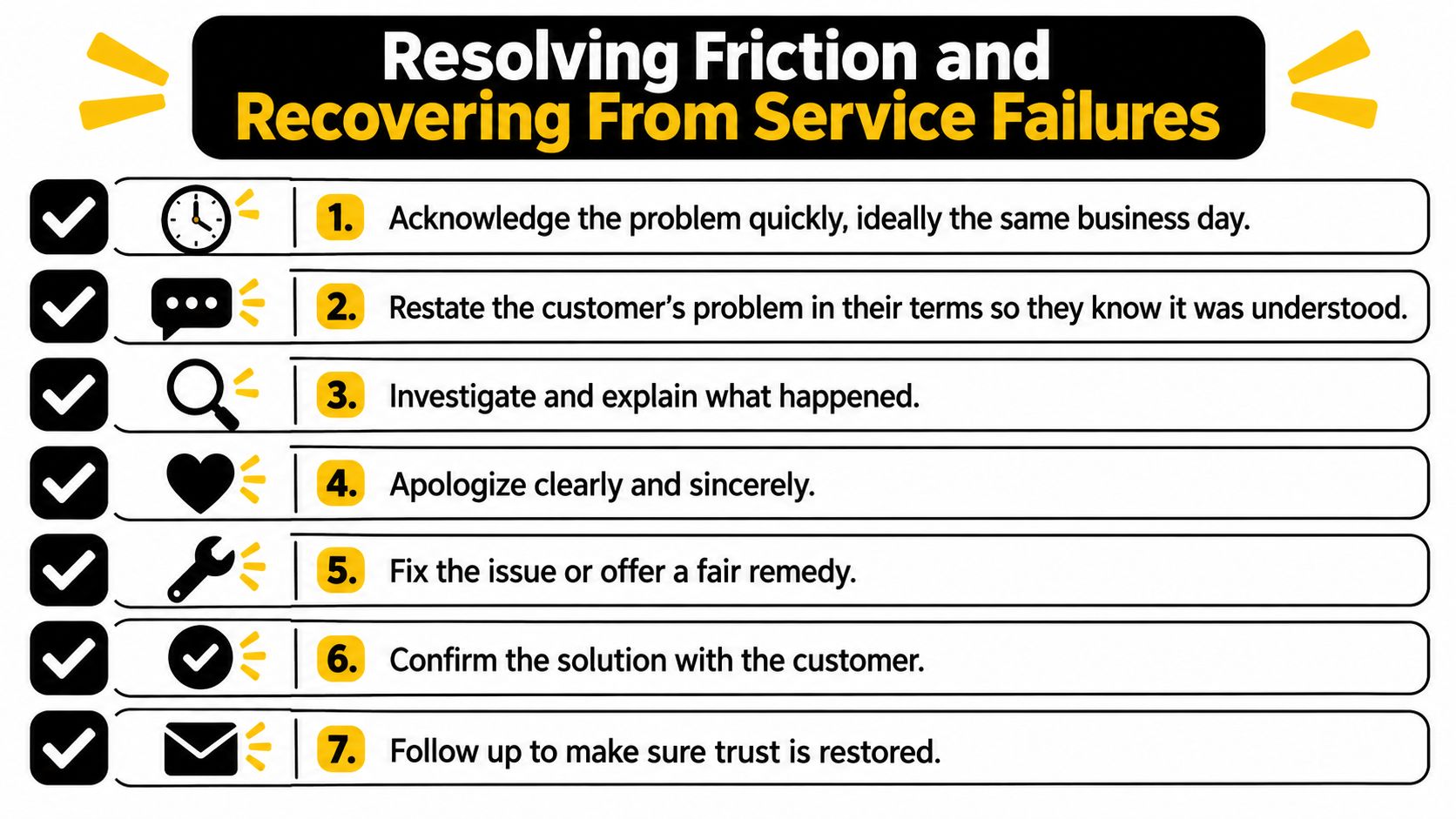
- Acknowledge quickly. Reply the same business day where possible, even if you only confirm receipt, name the owner, and give the date for a fuller answer.
- Restate the problem. Put the customer's problem back to them in their terms so they can correct you before you investigate the wrong issue.
- Investigate with a record. Open a case note with dates, evidence, photos or order details, and what the customer wants. Don't run recovery from memory or scattered messages.
- Explain the decision. Tell the customer what you found, what evidence you relied on, and why the remedy follows from it. Unexplained decisions feel arbitrary even when they're reasonable.
- Offer a proportionate remedy. Match the correction, replacement, rework, or refund to the actual harm. The largest available remedy isn't automatically the fairest, and overpaying one customer creates inconsistency for the next.
- Confirm resolution. Ask whether the fix worked after delivery or rework. Closing the ticket is an internal event. The customer's confirmation is the outcome you need.
- Fix the root cause. Record why the failure happened and change the checklist, supplier, training, or handover that produced it. Without this step, you're paying to recover the same failure repeatedly.
The checklist below gives staff those steps in the order they should use them.
Limits, Escalation, and Tracking
Give frontline staff clear remedy limits in money and type. For example, a service assistant might authorise rework or a small credit, while a full refund needs the owner. Written limits stop consistency depending on who's on shift, and they stop staff improvising generous promises the business can't keep.
Escalate billing errors, privacy issues, safety concerns, and repeated failures to a named owner the same day. These cases carry legal, financial, or safety consequences beyond normal dissatisfaction. Repeated failure also needs senior attention because the customer has already given you one chance to fix it.
Track time to acknowledgement, first-contact resolution, time to final resolution, repeat complaints, recovery satisfaction, and post-recovery repurchase. If acknowledgement is fast but repeat complaints stay high, your problem isn't courtesy. It's diagnosis or root-cause work.
Don't apologise and offer compensation before you understand what happened. A quick remedy for the wrong problem reads as careless, not generous.
I would review open cases every week by owner and age. Any case without a next step and a date is already drifting toward a second complaint. Recovery succeeds when the customer can see a process, not when your team can see a closed ticket.
Using Feedback and Personalisation Without Crossing the Line
Personalisation doesn't automatically build trust. It builds trust when the customer understands why you're using their information and can control it. When a message reveals knowledge the customer doesn't remember giving you, helpfulness turns into surveillance and retention suffers.
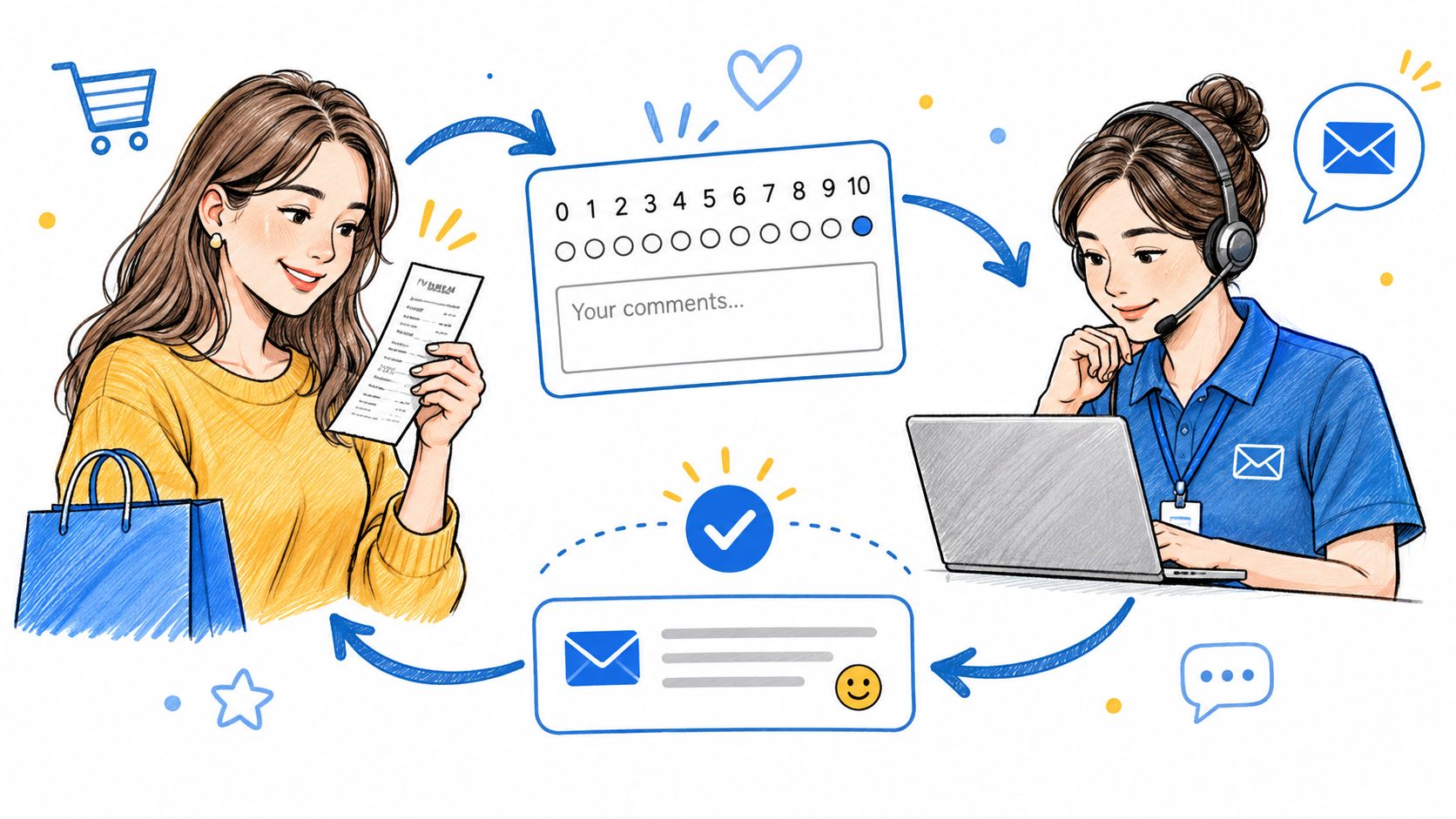
A feedback moment works best when it's tied to something concrete the customer just received, as shown here.
Feedback That Customers Can See Working
Ask one low-effort question after each purchase or job: "On a scale of 0 to 10, how easy was it to get what you needed?" Add an optional comment box for the reason behind the score. Long surveys get abandoned, and abandoned surveys tell you nothing except that you asked too much.
Route low scores to a named owner with a deadline for reply. A customer who takes time to say something was hard is giving you a recovery chance before she slips away unnoticed. Thank her, name the specific friction she reported, and say what you'll check and by when.
Then close the loop publicly. Send a short quarterly "you said, we changed" note naming the feedback and the operational change that followed, such as clearer delivery texts or a simpler returns form. Customers keep giving useful feedback when they can see it changes behaviour. They stop when every survey disappears into a dashboard.
The video below is useful for thinking about feedback as an operating input rather than a score to report.
Permission-Based Personalisation
The boundary is consent you can explain in plain language. PwC's 2025 customer experience survey of 5,511 US consumers found that 53% considered data sharing worthwhile when it made interactions smoother, but 93% said mishandling that data would cause them to lose trust. Customers will trade information for convenience. They won't forgive carelessness with it.
State four things wherever you collect data for personalised service:
- What data you use. Name it plainly, such as order history and preferred delivery day.
- Why it improves service. Explain the benefit in customer terms, such as a reorder reminder timed to their usual interval.
- How long you keep it. Give a retention period or the event that triggers deletion.
- How to opt out. Let customers stop personalised messages without losing basic service, ordering access, or support.
Contrast two messages. "Your usual filter is due for replacement next week based on your March order" is helpful because the source is obvious. "We noticed you looked at premium filters three times last night" exposes browsing the customer never knowingly shared for that purpose, and it invites suspicion about everything else you're tracking.
Measure consent withdrawals and complaints alongside repeat purchases. If personalised reminders lift orders this month while opt-outs climb each month, you're borrowing revenue from future retention. I would stop and redesign that sequence rather than celebrate the short-term response rate.
Confirm the First Retention Move for the Next 90 Days
Don't try to fix measurement, follow-ups, communication, recovery, and personalisation in the same month. Name the bottleneck that's costing you the most existing customers, then give it one owner, one test, and one decision rule for 90 days.
Match the First Move to the Symptom
If customers buy twice and then drift away, start with segmentation and timed follow-ups. Your problem is likely silence at the moment they'd normally reorder. If the same complaints keep returning, fix recovery and root causes first, because better follow-up messages will only send more customers into the same failure. If enquiries wait days for a useful reply, set the reply standard and account ownership before anything else, since customers can't trust a business they can't reach.
Use your baseline numbers to choose, not the loudest recent anecdote. One angry customer may point to a real process flaw, but a quarter of late repeat purchases is a pattern you can act on and measure. Write the bottleneck in one sentence: "Customers stop after the second order," or "Complaints recur because rework isn't checked." That sentence decides what the next 90 days are for.
The 90-Day Plan
| Phase | Actions | Output |
|---|---|---|
| Weeks 1 to 2 | Calculate baseline metrics and assign one owner per account | Baseline retention rate and owner list |
| Weeks 3 to 6 | Run triggers with a 10% holdout group | Purchase counts for contacted versus control customers |
| Weeks 7 to 12 | Review results and expand only what beats the holdout and protects margin | Keep or drop decision for each intervention |
In weeks 1 to 2, finish the baseline and clean the customer list. Assign every active and high-value account to a named owner, and make sure last purchase dates and complaint histories are visible in one place. Don't launch new messages during this phase. You're building the record that makes every later claim testable.
In weeks 3 to 6, run one intervention with a holdout group. That might be due-customer triggers, a same-day acknowledgement standard for complaints, or a post-purchase ease question with named follow-up. Keep the message, timing, and owner constant during the test. If you change three variables at once, you'll know something changed but not what caused it.
In weeks 7 to 12, review retained customers, repeat purchases, complaint recurrence, and contribution margin. Expand only what beats the holdout. If contacted customers buy more but only because you attached a discount that erased the margin, that's not a retention win. It's a more expensive way to sell the same order.
Keep-or-drop rule: Keep an intervention only if it retains more customers than the holdout and protects contribution margin.
Review the results in a short weekly meeting with the account owners. Bring the customer list, not just the summary percentage. Naming which customers returned, which didn't, and what blocked the follow-up turns a metric into operational work your team can correct the same week.
Start this week with the baseline export and the owner list. If follow-ups and enquiry handling keep slipping because repetitive manual work eats the day, fix that handling system as your first move rather than adding another campaign on top of it. The first conversation should be about your current bottleneck, because that's where retained customers are being lost.
If your retention work keeps slipping because enquiries, follow-ups, and updates depend on memory and manual chasing, Producant helps owner-managed businesses build consistent enquiry handling and follow-up systems with less repetitive hands-on work. Visit the site to start a conversation about your current bottleneck and the first practical change worth testing over the next 90 days.